Zosima’s duel and conversion
The Brothers KaramazovZossima’s duel and conversion is the remembered crisis in which Zossima’s military life gives way to repentance and a monastic vocation. The duel is not the event that changes him by itself: the decisive turn comes when he recognizes that his violence toward Afanasy has exposed the moral failure behind his former life, and he responds by asking forgiveness, refusing to continue the duel, and resigning his commission to enter a monastery.
Background and the turn toward the duel
The recollection places the duel at the end of June. The meeting is arranged for seven the following morning, on the outskirts of town. Zossima describes the duel as a custom deeply rooted among officers, even though duelling was punishable. Its acceptance helps explain how readily he enters a ritual of armed retaliation, but the recollection’s turning point comes the evening before the meeting, when he returns home in a savage mood and strikes his orderly, Afanasy.
The account makes that assault central to what follows. Zossima’s own conduct, rather than an injury inflicted by his opponent or fear of death, becomes the moral fact he cannot escape. The duel thus approaches under the shadow of a prior act: before he can face an adversary, he must face the wrong he has done to someone under his authority.
Recognition and apology
On the way to the meeting, Zossima tries to understand his distress. He considers whether he fears being killed, then recognizes that this is not the cause. His thoughts return to the previous evening, when he struck Afanasy. In recollection, he sees the assault again: Afanasy had stood rigidly, his head erect and his eyes fixed forward, enduring the blows without daring to move. The remembered scene redirects Zossima’s attention from his own danger to the man he had wronged.
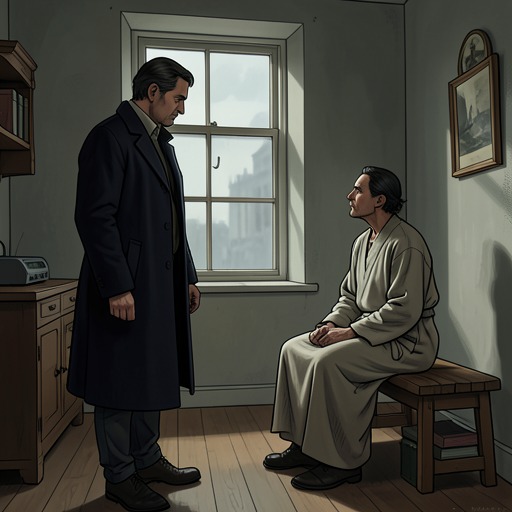
Zossima asks his companions to wait while he returns alone to Afanasy’s room. He acknowledges that he struck him the day before and asks for forgiveness. The apology precedes the duel’s decisive reversal: instead of treating the encounter as a test of military honor alone, Zossima has begun to act on the recognition that he owes an account to the person he injured.
The duel and refusal to shoot
At the appointed place, the two men stand twelve paces apart, and Zossima’s opponent has the first shot. Zossima stands openly, looking his adversary in the face; the shot grazes his cheek and ear. He calls out in gratitude that no one has been killed, then turns and throws his own pistol far into the wood, declaring that the weapon belongs there. He does not fire back.
That refusal changes the meaning of the meeting. The expected exchange of violence ends with Zossima disarming himself rather than completing the duel. The physical danger has not been absent—the other man has fired—but Zossima’s decisive act is to reject retaliation after surviving the shot. His earlier apology to Afanasy and his refusal to shoot belong to the same moral movement: he abandons the idea that honor requires answering violence with violence.
Resignation and conversion
After the duel, Zossima tells his companions not to worry about his leaving the service because he has already submitted his papers. He says that, once discharged, he will enter a monastery, and that this is the purpose of his departure from the regiment. The decision gives the duel a consequence beyond the immediate confrontation: Zossima leaves the military world in which duelling is treated as a deeply rooted custom and chooses a religious life instead.
The recollection presents conversion through a sequence of concrete acts rather than as a sudden change of doctrine: Zossima recognizes the violence he has done to Afanasy, returns to ask forgiveness, survives his opponent’s shot without returning fire, and announces his resignation and intended entry into the monastery. The duel becomes the hinge between the officer he has been and the life he resolves to undertake. Its significance lies less in victory over an adversary than in the renunciation of retaliation and the beginning of responsibility for his own actions.